

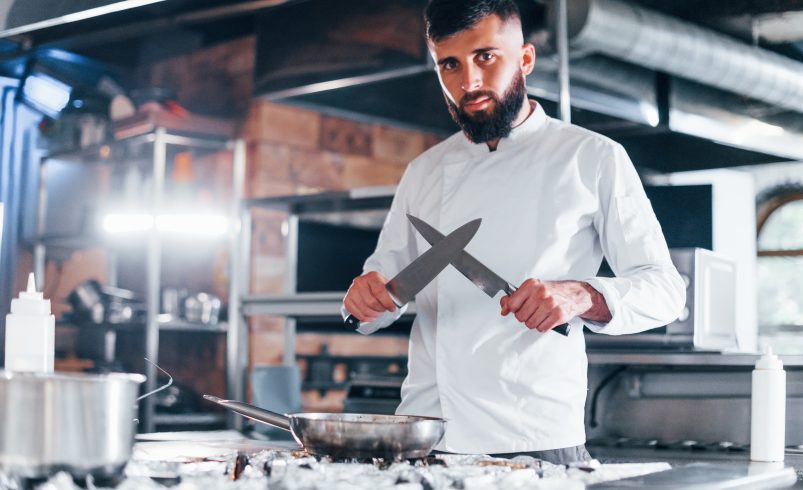

Evaluating a Halal chef’s skills requires a two-track assessment: you must rigorously test their universal culinary craftsmanship while simultaneously stress-testing their specialized knowledge and integrity within the Halal framework. A maestro in one area but negligent in the other is a liability.
Here is your comprehensive, actionable evaluation protocol.
Phase 1: The Pre-Screen: Portfolio & Philosophy Review
Before they touch a pan, assess their mindset and history.
A. Digital Portfolio Deep Dive (Instagram, Website, CV):
- Look for Process, Not Just Plating: Do they show butchery, spice blending, dough work? Or only finished plates? A true craftsman documents the journey.
- Sourcing Transparency: Do they tag or mention specific Halal suppliers, certifiers, or farms? This indicates professional networking and pride in provenance.
- Niche Authority: Does their content show deep dives into a specific regional cuisine (e.g., “The 5 types of Persian rice”)? This signals passion and expertise.
B. The “Philosophy Interrogation” (Initial Call):
Ask: “If you had to choose one dish that best represents your approach to Halal cuisine, what would it be and why?”
- Listen For: Do they describe technique, sourcing, and cultural story? Or just the flavor? The former shows depth.
Phase 2: The Practical Assessment: The “Triple-Test” Kitchen Audition
This is the core evaluation. Design a 3-4 hour paid audition that tests foundational skill, adaptability, and Halal-specific ingenuity.
Test 1: The Foundation & Technique Test (The “Non-Negotiable” Skill)
Objective: Assess fundamental knife skills, heat control, and palate. This is cuisine-agnostic.
- The Task: Provide them with a whole, Halal-certified chicken and a selection of vegetables (onion, carrot, celery, herbs).
- The Ask: “Please demonstrate your fabrication technique and prepare a classic, clear chicken consommé.”
- What You’re Evaluating:
- Butchery: Respect for the animal, precision, yield, and organization of parts (breasts, thighs, wings, carcass for stock).
- Technical Mastery: Consommé is a litmus test. It requires clarification, flavor extraction, and precision. Is it crystal clear? Is the flavor deep and balanced without reliance on non-Halal bases?
- Mise en Place & Cleanliness: Is their station organized? Do they work cleanly?
Test 2: The “Within-Bounds” Creativity Test (The Adaptability Skill)
Objective: Assess their ability to innovate and problem-solve within Halal constraints.
- The Task: Provide a “Mystery Basket” of 3-5 local, seasonal ingredients and one premium Halal protein (e.g., duck breast, lamb loin). Include one common non-Halal ingredient challenge (e.g., a bottle of sherry vinegar, a packet of gelatin, a sauce with “natural flavors”).
- The Ask: “Create one composed dish. You must use the protein and at least two other ingredients. For the challenge item, you must either: a) verify its compliance using the provided spec sheets, or b) articulate why you would reject it and propose a compliant alternative.”
- What You’re Evaluating:
- Ingredient Intelligence: Do they instinctively ask for spec sheets? Can they identify the compliance risk?
- Creative Flavor Pairing: How do they combine ingredients? Is it thoughtful or chaotic?
- Plating & Presentation: Eye for detail and modern sensibility.
Test 3: The Signature Dish & Explanation Test (The Depth & Culture Skill)
Objective: Assess their pride, technical depth, and cultural knowledge.
- The Task: They prepare one signature dish from their repertoire that they believe showcases their expertise in Halal cuisine.
- The Ask: As they cook, they must narrate their process. “Why this cut? Why toast the spices whole? What is the story or tradition behind this dish?”
- What You’re Evaluating:
- Narrative Ability: Can they teach and tell a story? This is crucial for leading a team.
- Technical Nuance: Are they controlling variables (e.g., resting meat, temperature of oil for frying)?
- Cultural Authenticity vs. Interpretation: Is this a faithful rendition, or a thoughtful modern twist?
The Halal-Specific Evaluation Checklist: What to Observe
During all tests, watch for these critical behaviors:
| What to Watch For | Green Flag (Expert) | Red Flag (Novice/Risk) |
|---|---|---|
| Upon Entering Kitchen | Immediately surveys equipment, asks about hood ventilation, checks oven temps. | Starts cooking without assessing tools or space. |
| Ingredient Handling | Asks for certification paperwork for the main protein without prompting. Handles meat with respect. | Takes ingredients at face value; is rough or wasteful with premium cuts. |
| Cross-Contamination Vigilance | Requests specific colored boards/knives if not provided; cleans station before switching tasks. | Uses whatever tool is closest; drips or spills without immediate cleaning. |
| Taste & Seasoning | Season in layers; taste constantly; balance is precise. | Seasons once at the end; dish is over/under seasoned. |
| “The Pivot” | When something goes wrong (e.g., over-reduced sauce), calmly articulates a solution. | Shows frustration; tries to hide the error. |
Phase 3: The In-Depth Interview & Scenario Q&A
Post-cooking, sit down for a focused discussion.
Ask These Follow-Up Questions:
- On the Dish They Just Made: “Walk me through the food cost for that signature dish. What’s the most expensive component and how would you manage its yield?” (Tests business acumen).
- On Crisis Management: “During service, you see a cook use the vegetable tweezers to pull a piece of lamb from the grill. The lamb is now on a guest’s plate. What are your next 5 steps?” (Tests protocol under pressure).
- On Menu Development: “Our menu needs a vegan, Halal dessert that isn’t fruit salad. What’s your concept, and what stabilizer would you use instead of gelatin?” (Tests innovative, compliant R&D).
The Scoring Rubric: A Quantitative Evaluation
Rate the candidate (1-5) in each category. A candidate for a Head Chef role should average 4+.
| Category | Evaluation Criteria | Weight |
|---|---|---|
| Technical Foundation (Test 1) | Knife skills, butchery yield, consommé clarity/flavor, station organization. | 25% |
| Adaptive Creativity (Test 2) | Flavor pairing, problem-solving with “mystery” item, plating creativity. | 20% |
| Cultural & Technical Depth (Test 3) | Dish authenticity/innovation, narration skill, technical execution. | 20% |
| Halal Operational Intelligence | Proactive sourcing inquiry, cross-contamination vigilance, waste awareness. | 25% |
| Leadership & Communication | Clarity of explanation, calm under test pressure, response to scenario Qs. | 10% |
Overall Score: ______ / 5
The Final, Critical Step: Reference Checks with a Focus
When calling their previous employers, ask these specific questions:
- “Did they have autonomy over sourcing Halal suppliers, or did they just follow a list?”
- “Can you give me an example of how they improved kitchen efficiency or reduced waste related to premium Halal ingredients?”
- “How did they handle a conflict between speed and protocol during a rush?”
The Verdict: You are not hiring a cook. You are hiring a Culinary Executive Officer for your brand’s most sensitive department. Their skill must be matched by an operational piety that is systematic, not performative. The evaluation process must be as rigorous and multi-dimensional as the role itself. By following this protocol, you move beyond taste and into the true anatomy of mastery.